Gentoo Linux as a Host System for High-Availability Clusters
Introduction
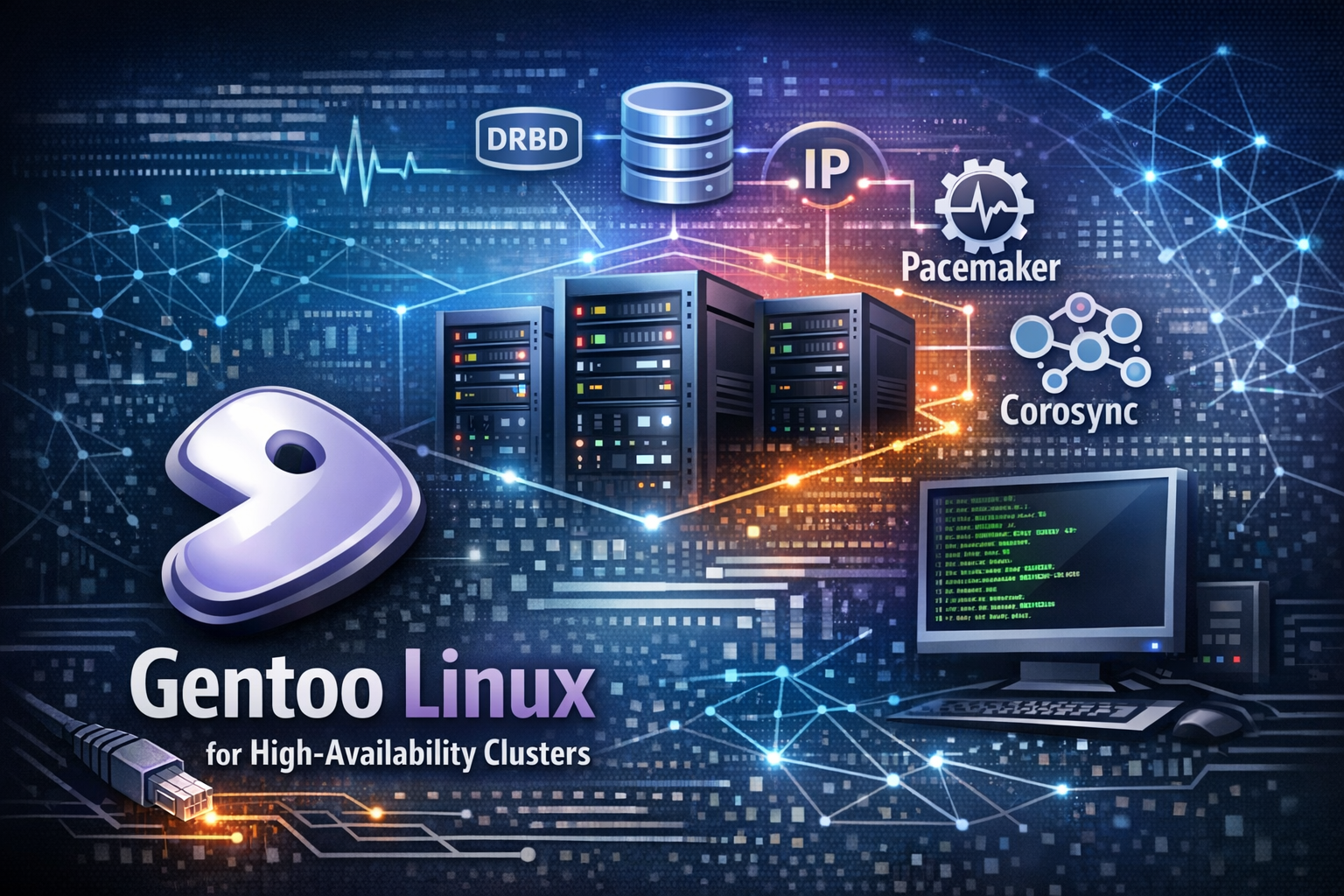
When people pick a base OS for a high-availability (HA) cluster, the shortlist is usually two or three "enterprise" distros. Gentoo rarely makes the cut — too unusual, too much hands-on. Yet it has traits that fit HA rather well: you control exactly what is installed and how it's built, there's no bloat by default, a single packaging system (Portage), and you can tune the system for your hardware and workload. Below is why Gentoo can be a considered choice for such a cluster, not just an exotic one.
What we mean by a high-availability cluster
Here, high availability isn't "monitoring plus auto-restart." It's an setup where losing one node doesn't mean losing the service. Usually that means several machines with shared or failover state, a shared or distributed resource (IP, storage, application), quorum, and fencing so you don't get split-brain. A typical stack is Pacemaker and Corosync, plus DRBD, LVM, cluster filesystems, or replicated databases as needed. The host OS has to run this stack reliably, not get in the way, and ideally not surprise you at upgrade or config-change time.
Full control over what's on the system
On Gentoo nothing is installed "by the way." What ends up on the system is up to the admin: USE flags, keywords (stable vs testing), masks, and sets. On an HA cluster that means no extra daemons, no extra libraries, no surprise dependencies. Smaller attack surface, fewer background processes, fewer chances for odd resource usage or port/library conflicts. After install you can literally list which packages are there and with which options — that makes it easier to replicate the setup on a new node and to audit.
Building from source isn't the goal in itself; it's how you get consistency. Same compiler options, same library versions on every node. For a cluster that matters: differences in glibc, OpenSSL, or system libs can cause subtle bugs under failover or replication.
Predictable upgrades and dependencies
Portage keeps the full dependency and version tree. Upgrades are deliberate: you can see what will be pulled in, what will be rebuilt, what's masked or conflicting. On other distros, "apt upgrade" or "yum update" often drag in dozens of packages you didn't think about; on Gentoo that doesn't happen unless you enable extra USE flags or move to unstable without a reason. For HA that reduces the risk of "upgrade because we could," after which the cluster behaves differently or starts flapping.
The tradeoff is that upgrades take time (rebuilds) and disk (sources, build dirs). In a cluster you usually handle that by updating one node at a time: update, verify, then the rest. That fits the "look first, then apply" approach.
Tuning for your hardware
Gentoo lets you build packages for your actual CPU (march, mtune, etc.) and drop unneeded features. On a cluster of similar servers that pays off: the same tuned build is deployed everywhere. The gain over generic binary packages may be small, but under heavy load (databases, strict-SLA apps) even a few percent can matter. You also get fewer "black box" optimizations and abstractions, so it's easier to see where CPU and memory load come from.
Single config model and reproducibility
System configuration in Gentoo lives in clear places: /etc/portage/ (make.conf, use flags, masks, sets), plus /etc/local.d/ if you use it, and the usual /etc for services. There's no extra config layer on top of the package manager. With automation (Ansible, Puppet, custom scripts) that makes "desired state" simple: same files and commands on every node. A stage3 plus your overlays and configs gives you a reproducible base; on top of that you add the cluster stack and apps.
For HA, nodes should be as identical as possible. Gentoo supports that: same stage3, same USE and keywords, same emerge sequence, and you get a predictable environment on each node.
Support for the cluster stack
Pacemaker, Corosync, DRBD, resource agents and related packages are in Portage. Versions are usually in line with current stable upstream; if you need something newer you can pull test ebuilds or write your own. In practice, a typical HA stack (Pacemaker + Corosync, maybe DRBD and LVM) runs fine on Gentoo; most docs and examples target RHEL/CentOS, but configs and concepts carry over. The important part is understanding quorum, fencing, and resource dependencies; the OS is secondary.
Where it can get tricky is with less common agents or vendor software that only targets RHEL/SUSE. Then you either find equivalents in Portage or run that software in containers/VMs with a suitable distro inside, and keep Gentoo as the host.
Deployment time and skills
The downside of Gentoo is that initial deployment and upgrades take longer than installing a binary distro. For a cluster that's often acceptable: you have a few nodes, you deploy once or rarely, and then the system behaves predictably. The other cost is the learning curve. Someone who's never used Portage, USE flags, or source builds will need more time at first. For teams that already use Gentoo, you get the same control and consistency without compromise.
Stability and long-term use
Gentoo is rolling release: there are no fixed major versions with an end-of-life date. So you don't have to "migrate" to a new major, but you do need to track and test updates yourself. On an HA cluster you usually adopt a conservative policy: update selectively and only after testing on a spare node or lab. In that mode Gentoo is stable; issues are more often due to human choices (wrong USE, hasty upgrade) than to the distro itself.
Network stack and performance
Kernel and networking are built with the options you choose. You can enable only the protocols and drivers you need and leave out the rest — less code, fewer failure modes. For a cluster with a lot of traffic (replication, heartbeat, DRBD) that helps: less noise in the kernel and in the network config. Fine-tuning (buffers, queues, offload) works the same as on other Linux; the difference is you don't have to ship modules and options you don't use.
Summary: pros and cons
Gentoo gives an HA cluster: minimal, controlled system composition, predictable dependencies and upgrades, hardware-specific tuning, and reproducible config across nodes. The cluster stack (Pacemaker, Corosync, etc.) is in Portage and works. The cost is more time for initial setup and upgrades, and a team that's comfortable with Gentoo.
For teams that already run Gentoo or are willing to learn Portage and source builds, this is a considered choice — not exotic, but consistent with how they want to manage the system and dependencies. For those who prefer "by-the-book RHEL" and minimal customisation, binary distros will stay the obvious path. Bottom line: Gentoo as a host for an HA cluster is a realistic, technically sound option when the priorities are control, predictability, and node uniformity, rather than the fastest possible "out of the box" install.